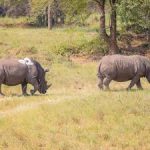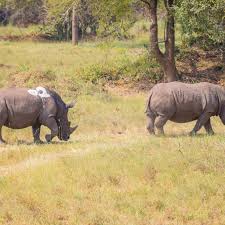
The return of rhinos to Kidepo Valley National Park marks an important step in Uganda’s wildlife conservation efforts. For more than four decades rhinos had disappeared from all Uganda’s national parks. Their reintroduction in Kidepo Valley represents a gradual effort to restore species that were once part of the country’s ecosystem. The rhinos introduced into Kidepo were moved from Ziwa Rhino Sanctuary, which is Uganda’s main rhino breeding and conservation center. Ziwa rhino sanctuary was established in 2005 after rhinos had disappeared from the wild in Uganda. The sanctuary started with a small group of southern white rhinos brought from Kenya and has since grown its population through controlled breeding and strict protection.
Before the relocation, conservation teams prepared a protected area within the park where the rhinos could settle and adapt to their new environment. This area includes fencing, ranger patrol points and monitoring systems to reduce risks such as poaching or disturbance. The translocation process involved veterinary teams, wildlife experts and UWA rangers who ensured the animals were safely transported over a long distance from central Uganda to the northeastern part of the country.
The goal of the first phase is to introduce a small number of rhinos and allow them to adapt before increasing the population gradually. This careful approach helps reduce stress on the animals and allows conservation teams to monitor their behavior and health closely.
Kidepo Valley National Park is one of the most remote national parks in Uganda. It is located in the northeastern part of the country in the Karamoja region close to the borders with South Sudan and Kenya. The park was established in 1962 and covers about 1,442 square kilometers. The park is dominated by open savannah plains, seasonal rivers, rocky hills and mountain ranges. The park also features Narus valley and Kidepo valley. The Narus valley holds water for most of the year and attracts large numbers of animals. This is the main area where game viewing is done. Kidepo Valley National Park has a variety of mammals which include elephants, buffaloes, lions, giraffes and several antelope species.
History of rhinos in Kidepo Valley National Park
Rhinos were once part of the wildlife that lived in the plains of Kidepo valley. Both black rhinos and white rhinos existed in northern Uganda in earlier decades. However, during the 1970s and early 1980s, rhino populations in Uganda declined rapidly. Political instability in the country weakened wildlife protection. At the same time, rhino horns were highly valued in illegal wildlife trade which increased poaching. As a result, rhinos were gradually hunted until their numbers collapsed. The last known rhino in Kidepo was killed in 1983 and the species disappeared from the park for more than 40 years. The recent re-introduction therefore represents the first attempt to restore rhinos to the park.
Kidepo Valley National Park is known for hosting wildlife species that are uncommon in other parts of Uganda. Among the rare mammals in the park are cheetahs, caracals, bat-eared foxes, striped hyenas, aardwolf and the lesser kudu. The park also supports large populations of buffaloes, elephants and giraffes that move across the open plains. The park also hosts endemic bird species like Karamoja Apalis, Black breasted barbet, Abyssinian Roller, Jackson’s hornbill, common Ostrich, fox cisticola, Red winged lark, Golden pipit and clapperton’s Fronclin.
Why the Return of Rhinos is Important
The return of rhinos to Kidepo is important for several reasons.
First, it helps restore a species that once lived in Uganda’s ecosystems but disappeared due to human activities. Reintroducing rhinos allows conservationists to rebuild a population that may eventually grow and spread to other suitable habitats.
Second, rhinos contribute to the ecological balance of savannah landscapes. As large grazers and browsers, they influence vegetation patterns and create habitats that benefit other wildlife species.
Lastly, the project strengthens conservation awareness in Uganda. It shows that with long-term planning, protection, and cooperation between conservation organizations and government agencies, it is possible to restore species that had been lost from the wild. The return of rhinos to Kidepo therefore represents both a conservation effort and a reminder of the importance of protecting wildlife for future generations.